News & Insights
How Mercury is Retrofitting Live Data Centres for AI Workloads
AI workloads are increasing rack densities, power demand and cooling requirements across the European data centre industry. Much of the existing infrastructure across the region was not designed for this level of capacity. Upgrading live environments without interrupting mission critical operations has become one of the sector’s most complex challenges.
Our dedicated Data Centre Retrofit and Fit-Out business unit positions Mercury to upgrade live facilities to meet this growing demand.
Mercury’s DCRF team delivers complex upgrades within operational environments, increasing capacity and introducing new power and cooling architecture to support high-density AI zones within existing buildings.
Data Centre Retrofits and Fit-Out Managing Director John Crawford has every confidence in Mercury as the partner of choice for our clients in live environments.
We understand what it takes to work within operational facilities where downtime is not an option. Our teams are experienced in delivering complex upgrades while maintaining performance, safety and programme certainty. That is what our clients rely on.
The success of these projects is shaped at preconstruction stage. In live environments, early design decisions carry through the entire delivery process and directly influence how upgrades are executed.
Stephanie Hofmann, Preconstruction and Design BU Manager at Mercury, continues:
“AI workloads are reshaping the physical limits of data centres, and upgrading live environments safely depends on precision in early planning. Within our Preconstruction and Design team, we engineer clarity from day one, integrating scalable power and advanced cooling solutions before works begin. That is how we turn high-density AI demand into predictable, low-risk delivery for our clients.”
Live-environment retrofits are our daily business. We specialise in upgrading operational data centres, integrating new power, cooling and AI-ready infrastructure into facilities that cannot afford downtime. That experience allows us to deliver with confidence, predictability and precision.
This approach is supported by modular delivery and off-site manufacturing, reducing on-site intervention while strengthening control over programme and risk.
“We are bringing existing facilities forward so they can support the demands of the AI age.”
With a clear shift toward sustainability and modularity, clients are looking for solutions that are scalable, energy efficient and delivered with minimal disruption. Mercury’s experience in live environments ensures upgrades are carried out safely and with a high degree of control, even in demanding operational settings.
Speaking at the Data Centre World panel “From Grid to Chip: Rethinking the Data Centre Ecosystem for AI Workloads” in Paris, Mercury Project Design Manager Corentin Tridon outlined how modular delivery is enabling AI-driven upgrades in live environments.
We have the capability to fabricate elements such as ePods, chilled water skids and service modules offsite.
“Our off-site manufacturing facilities reduce on-site works to controlled lifting and tie-ins. That approach is critical when upgrading infrastructure in operational facilities.”
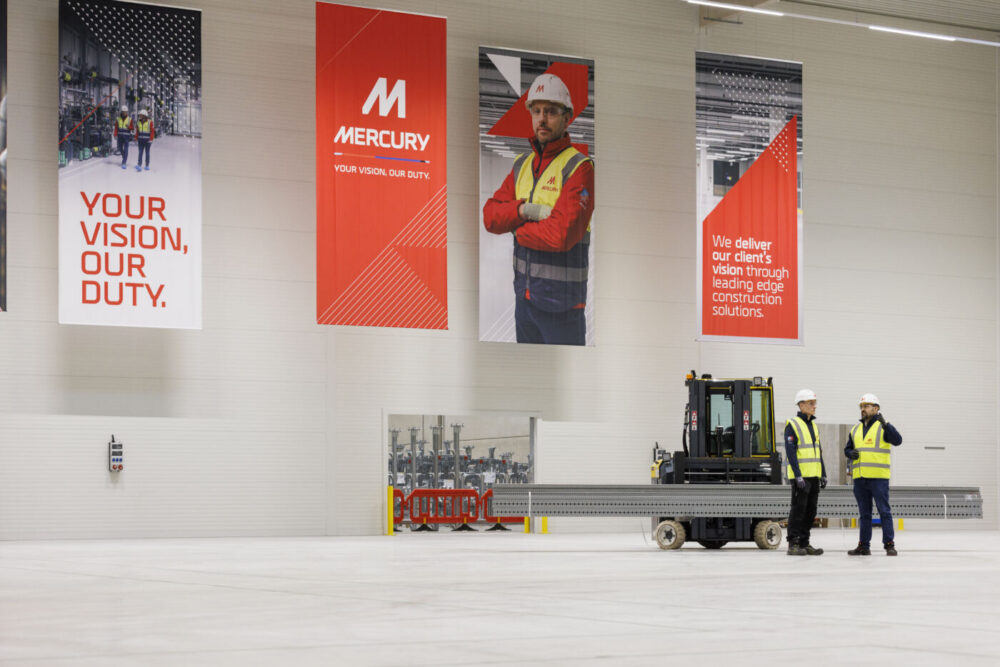
Mercury’s off-site manufacturing capability supports this model through our OSM hub in Schönebeck, Germany. Fabricating key infrastructure components in controlled environments improves programme certainty while reducing disruption within live data centres. Combined with specialist retrofit expertise and structured delivery processes, this approach enables Mercury to upgrade operational facilities without compromising performance.